 Mthombeni Energy Revenue protection
Electricity Health Check
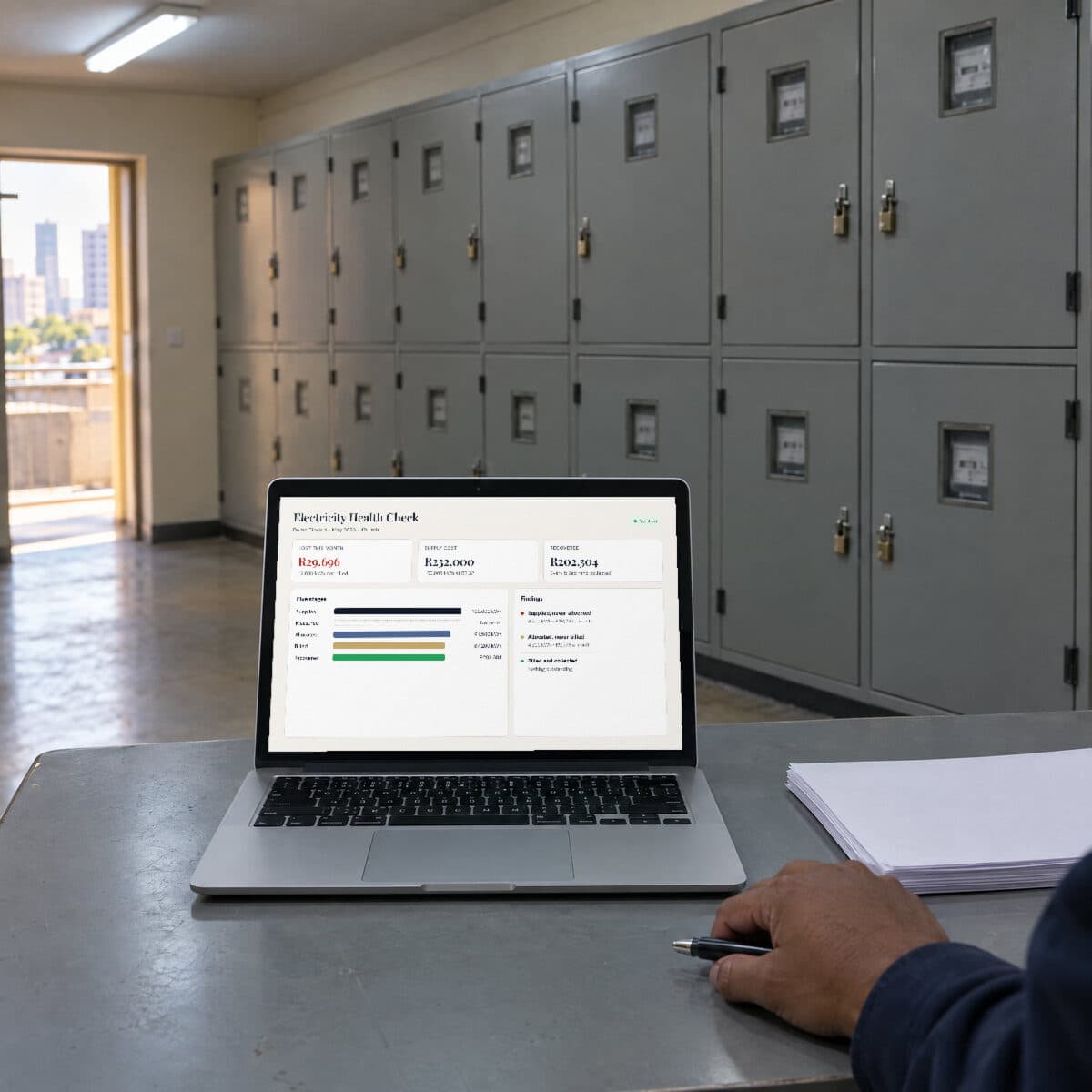
The Electricity Health Check is where Mthombeni Energy starts. We take your supply authority's bills, your meter readings and your tenant billing and collection records, reconcile them month by month, and show you where the building leaks, what it costs you each month and what we would look at first.
Every figure traced back to the bills and readings it came from
A Health Check is worth doing if
- You can't say what share of the electricity bill your tenants pay back
- Recoveries dropped and nobody knows why
- The bulk bill went up but occupancy didn't
- Meters, tenants or the billing agent changed recently
- You are taking over or buying a building
- Your auditors or trustees are asking about electricity recoveries
What the Health Check covers
Supplied
What the supply authority billed the building for, from the bills or your bulk meter.
Measured
What your own check and sub-meters recorded, where there are any, and what that says about the bulk reading.
Allocated
Whether every unit supplied was allocated to a unit, a common area or a known loss.
Billed
Whether every allocated unit was billed, at the tariff in force that month.
Recovered
What tenants paid against what they were billed.
The data itself
Missing or duplicated readings, meters that stopped and months with no tariff. A month that fails these checks gets no rand figure until it is fixed.
How we work, explained
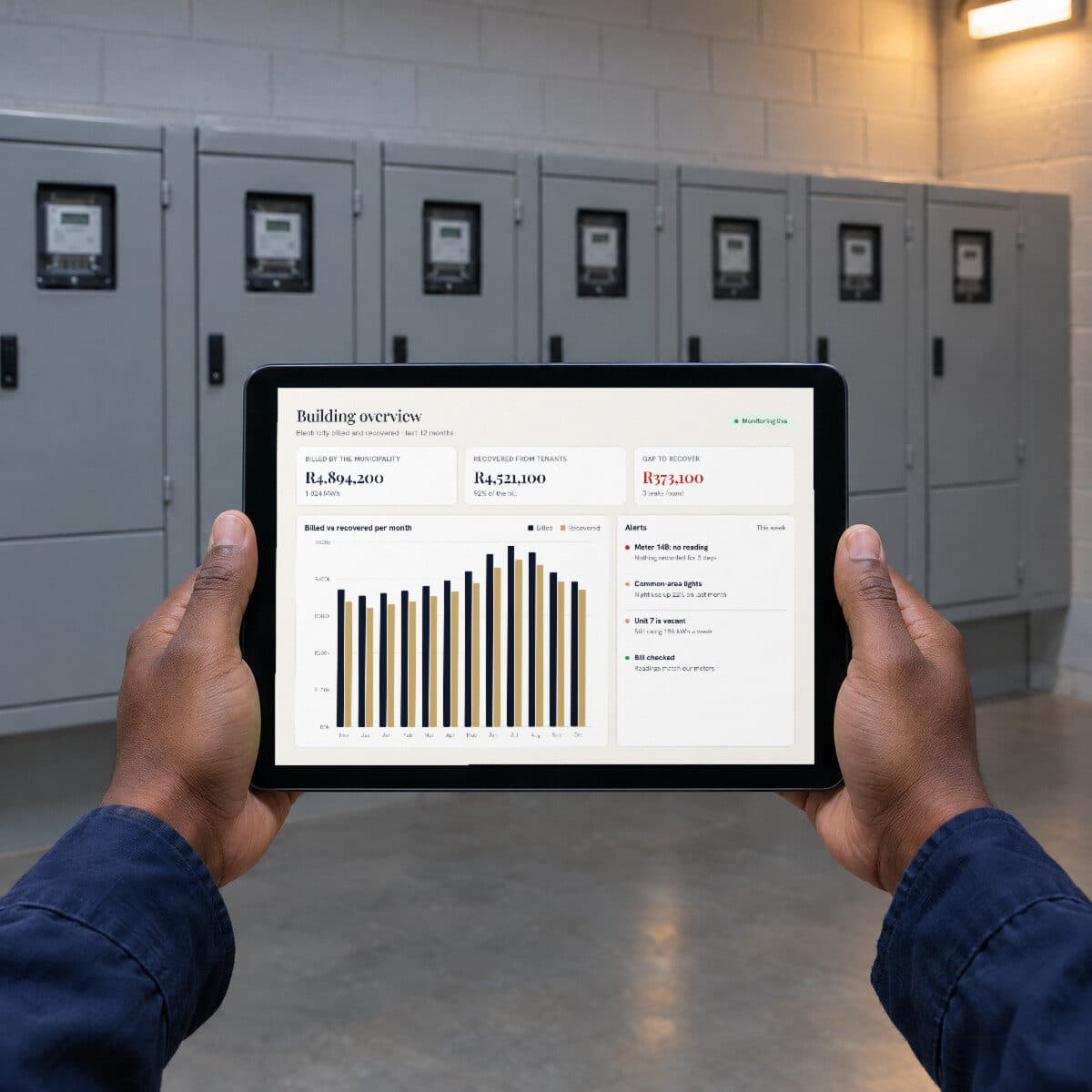
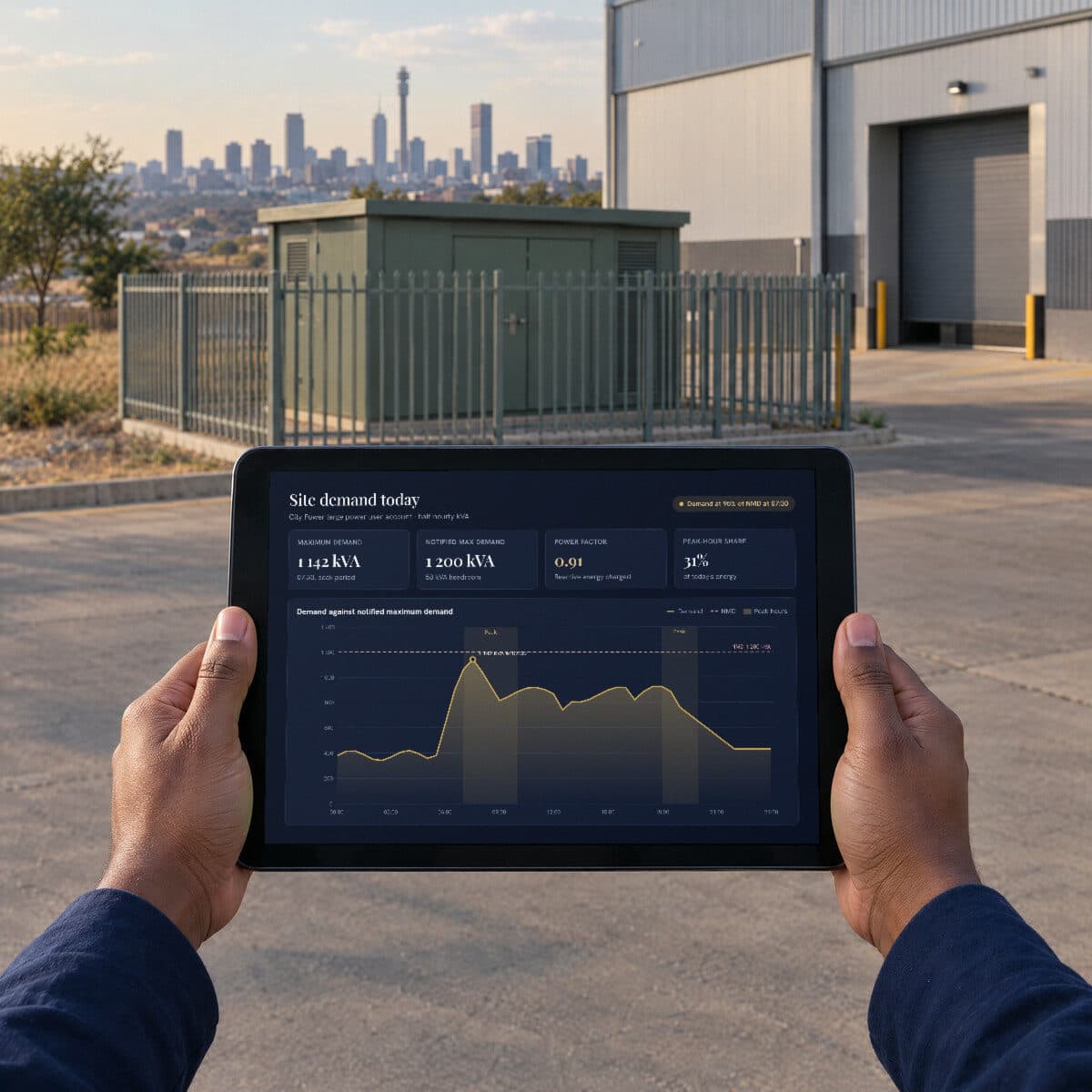
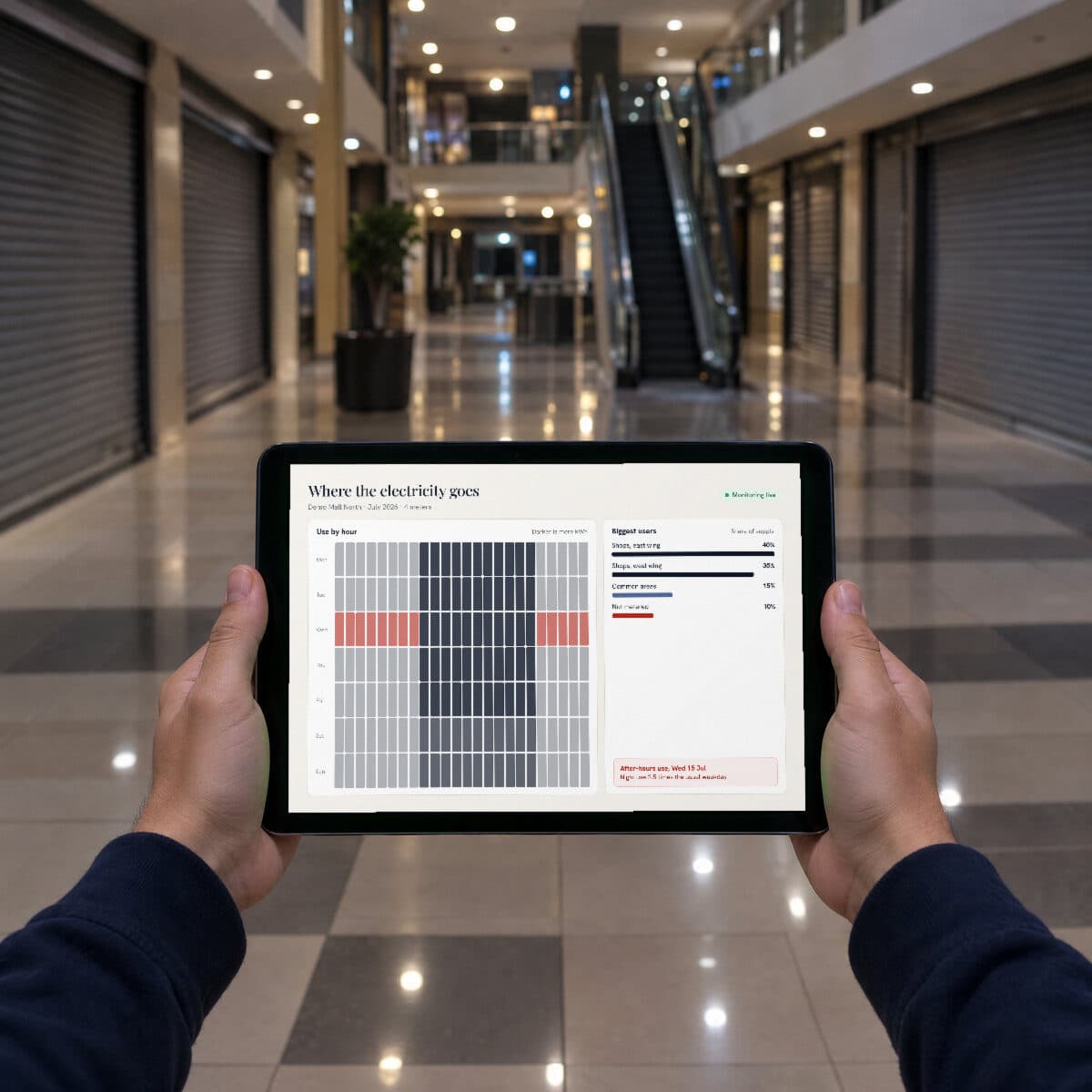
Pictures are illustrations of the work described.
How it works
- 1A call-back to talk through the building and what records you have.
- 2You send 12 to 24 months of bills, meter readings or exports, and tenant billing and collection records. Spreadsheets are fine, and units are identified by number, not by a tenant's name.
- 3We check every row and reconcile each month, stage by stage, at the tariff in force.
- 4If the records leave questions, a site visit to check the meters and find loads nobody is billed for.
- 5A report: the five stages for each month, every gap in kWh and rand with the arithmetic, the findings ranked by what is at stake, and what we would look at first.
- 6You decide what happens next: monitoring, billing corrections, a query on the bill or a fix.
Included
- Reconciliation of every month you send, up to 24 months
- Each gap in kWh and rand, with the arithmetic written out
- A list of findings with what is at stake
Not included
- Electrical work, which is quoted separately
- Querying or disputing a bill on your behalf: you decide, we give you the evidence
Worked example
What a Health Check shows: the five stages
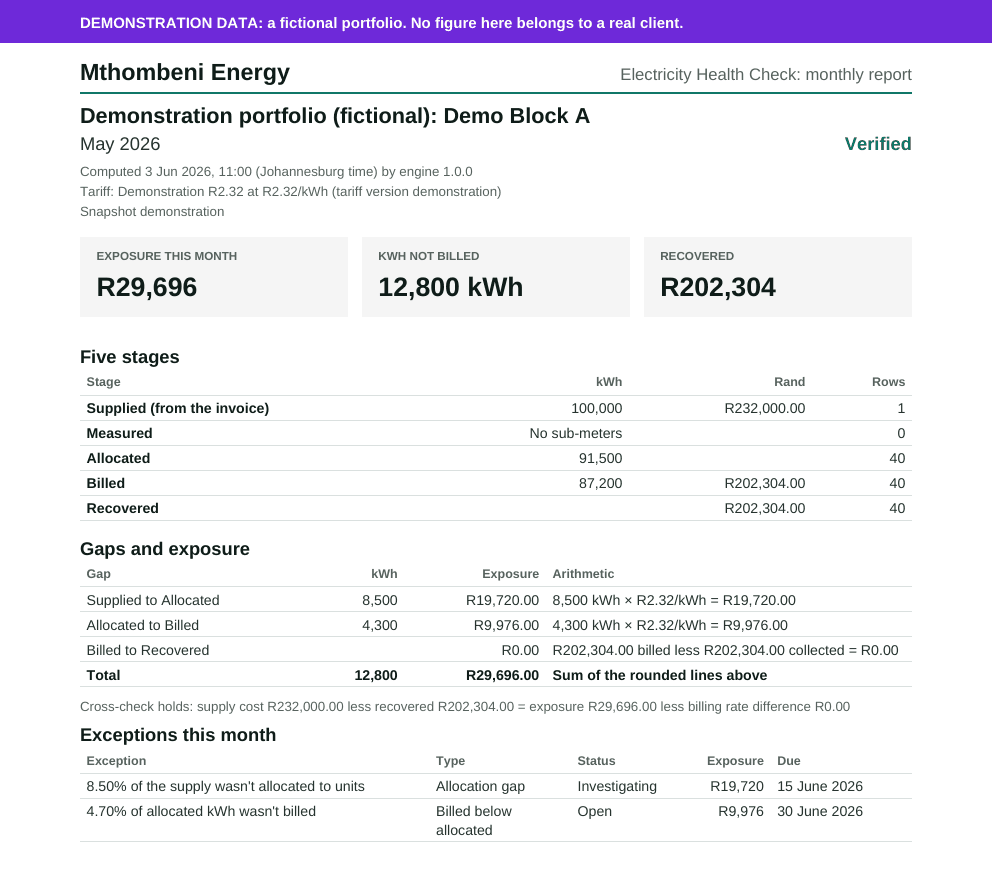
Every month we follow the electricity from what the supply authority billed to what your tenants paid. Each step down is a gap, priced at the tariff in force. This example uses demonstration figures: a fictional block of 40 units for one month at R2.32/kWh, worked out by the same engine that produces our reports.
- 1. Supplied100,000 kWhR232,000What the supply authority billed the building for
- 2. MeasuredNot meteredWhat the building's own meters recorded (no check meter in this example)
- 3. Allocated91,500 kWhWhat was allocated to the 40 units
- 4. Billed87,200 kWhR202,304What the units were billed
- 5. RecoveredR202,304What the units paid
| Gap | kWh | A month | The arithmetic |
|---|---|---|---|
| Supplied but never allocated to a unit8,500 kWh × R2.32/kWh = R19,720.00 | 8,500 kWh | R19,720 | 8,500 kWh × R2.32/kWh = R19,720.00 |
| Allocated but never billed4,300 kWh × R2.32/kWh = R9,976.00 | 4,300 kWh | R9,976 | 4,300 kWh × R2.32/kWh = R9,976.00 |
| Billed but not paidR202,304.00 billed less R202,304.00 collected = R0.00 | - | R0 | R202,304.00 billed less R202,304.00 collected = R0.00 |
| Lost a month | 12,800 kWh | R29,696 | The sum of the lines above |
When the data for a month is incomplete (missing readings, a meter that stopped, no tariff for the whole month), the report marks it unverified and shows no rand figure until it is fixed.
The monthly report
Figures your finance team can check
Each month you get a report you can hand to a CFO, a trustee or an auditor. Every number traces back to the readings, bills and tenant records it came from.
- The five stages and every gap, in kWh and rand, with the arithmetic written out
- A cross-check that the gaps add up to what the supply cost less what was recovered
- Data quality per meter: missing, duplicated or zero readings, and resets
- The tariff version used, so every rand figure can be checked
- Each finding for the month, with its owner, due date and status
Mthombeni Energy
After the Health Check
- Consumption monitoringSee where the building uses the most electricity and when: after-hours use, common areas, demand peaks and meters that stop.
- Revenue reconciliationSupplied, measured, allocated, billed and recovered, every month, with each finding tracked to an owner, a due date and an outcome.
- Bill and tariff auditsCity Power, Tshwane, Ekurhuleni and Eskom bills checked against the tariff in force and your own meters.
- Reports and analyticsA monthly report your finance team can check, with analytics on where the electricity goes and what changed.
- RecommendationsThe fix follows the monitoring: solar panels, power factor correction, load shifting or billing fixes. You decide.
- Large power usersStops leaks on City Power large power user bills in Johannesburg: bill and demand audits, check metering, and monitoring with monthly analytics reports.
Request a Health Check
Leave your name and number and we'll call you back to talk through the building and the records we need for your Electricity Health Check. Or message us on WhatsApp.
Questions
What do you need from us?
Your electricity bills from the supply authority, any meter readings or meter exports you have, and your tenant billing and collection records for the same months. If something is missing we tell you what, and which months it affects.
What if our records are incomplete?
We reconcile what you have. A month with missing readings, a meter that stopped or no tariff for the whole month is marked unverified and gets no rand figure, so you never see a number the data can't support.
Do you need our tenants' names?
No. Units are identified by their unit number. We take only the fields the reconciliation needs.
How long does it take?
It depends on how much data there is and what state it is in. Once we have seen your records we tell you when to expect the report.
What does it cost?
We tell you the price before we start, once we know the size of the building and how many months you want checked.
Can our finance team check the figures?
Yes. Every rand figure shows the kWh, the tariff and the arithmetic, and the gaps add up to what the supply cost less what was recovered.
Related services
- Revenue reconciliationSupplied, measured, allocated, billed and recovered, every month, with each finding tracked to an owner, a due date and an outcome.
- Consumption monitoringSee where the building uses the most electricity and when: after-hours use, common areas, demand peaks and meters that stop.
- Bill and tariff auditsCity Power, Tshwane, Ekurhuleni and Eskom bills checked against the tariff in force and your own meters.
- Reports and analyticsA monthly report your finance team can check, with analytics on where the electricity goes and what changed.
We cover Johannesburg, Sandton, Randburg, Roodepoort, Soweto, Midrand, Centurion, Pretoria, East Rand (Ekurhuleni), West Rand. Areas we cover